

How to Increase HRV Naturally
If you’ve ever looked at your Oura Ring, Garmin, Apple Watch, or WHOOP app, you’ve probably noticed a number called HRV, or Heart Rate Variability. At first glance, it can seem confusing. Is a higher number always better? Should you worry if it suddenly drops? And what does it actually say about your health?
Over the last few years, HRV has become one of the most talked-about health metrics, and for good reason. Unlike your resting heart rate, which simply measures how many times your heart beats each minute, HRV provides insight into how well your body is recovering, adapting to stress, and maintaining balance.
While no single number can define your health, HRV can offer valuable clues about how your nervous system is functioning and whether your lifestyle is supporting recovery or placing your body under more stress than it can comfortably handle.
In this article, we’ll explore what HRV is, why it matters, what affects it, and the evidence-based habits that can help improve it naturally.
What Is HRV?
Despite its name, Heart Rate Variability doesn’t measure how fast your heart beats. Instead, it measures the tiny differences in time between consecutive heartbeats.
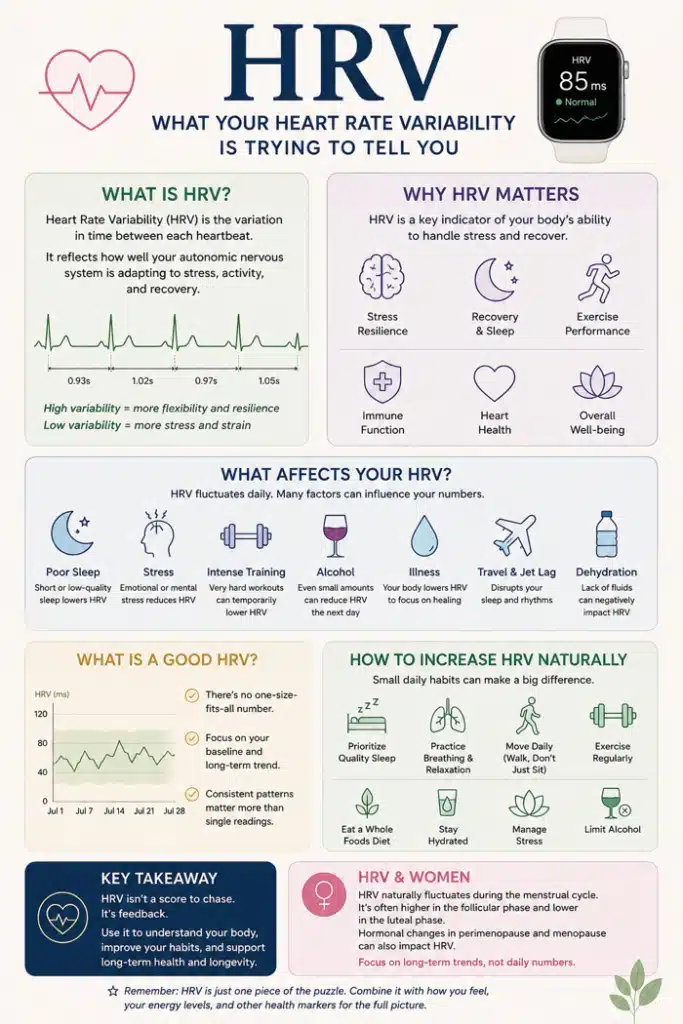
Although your heart may beat around 60 times per minute while you’re resting, those beats don’t occur exactly one second apart. One beat might come after 0.92 seconds, the next after 1.06 seconds, and another after 0.98 seconds. These small variations are a sign that your autonomic nervous system is constantly adjusting your heart rate to meet your body’s needs.
In general, a higher HRV reflects greater flexibility in your nervous system and a stronger ability to adapt to physical and psychological stress. A lower HRV may suggest that your body is under greater strain or hasn’t fully recovered from recent challenges.
It’s important to remember that HRV is not a measure of heart health in the same way as blood pressure or cholesterol. Rather, it’s a measure of resilience and recovery.
Why HRV Matters for Your Health
One of the reasons HRV has become such a popular health metric is that it offers a window into your autonomic nervous system, the system responsible for controlling functions like heart rate, breathing, digestion, and recovery without you having to think about them.
Your autonomic nervous system has two main branches. The sympathetic nervous system prepares you for action and is often described as the “fight or flight” response. The parasympathetic nervous system, often referred to as “rest and digest,” helps your body recover, repair tissues, and conserve energy.
When these systems work together effectively, your body can adapt to changing demands throughout the day. HRV reflects this adaptability. Rather than being fixed, it changes constantly depending on factors such as sleep, exercise, stress, illness, and even hydration.
A consistently healthy HRV has been associated with better cardiovascular health, improved stress resilience, and healthy aging. However, it’s the long-term trend that matters far more than a single night’s reading.
What Is a Good HRV?
This is one of the most common questions people ask, but the answer is often surprising.
There is no universal “perfect” HRV.
Age, genetics, sex, fitness level, and even the device you’re using all influence your readings. Two healthy people of the same age can have very different HRV values while both being perfectly healthy.
Instead of comparing yourself to someone else, focus on your own baseline. Most wearable devices calculate this automatically over weeks or months, allowing you to see whether your HRV is generally improving, remaining stable, or gradually declining.
A sudden drop after a poor night’s sleep or a stressful week isn’t usually a cause for concern. Persistent downward trends, however, may suggest that your body needs more recovery.

Support Your Cardiovascular Health
Healthy habits have the biggest impact on HRV, but I also include Nitralis® from DoNotAge in my daily routine.
Nitralis is designed to support nitric oxide production, helping promote healthy blood flow and cardiovascular function, two important foundations for overall health and longevity.
What Can Lower Your HRV?
One of the most useful aspects of HRV is how quickly it responds to everyday life.
Poor sleep, psychological stress, illness, overtraining, dehydration, and alcohol can all temporarily reduce HRV. Long flights, jet lag, and even unusually demanding workdays may have a similar effect.
Personally, one of the biggest changes I notice in my own HRV is after drinking alcohol. Even when I don’t feel particularly affected the next morning, my Oura Ring often tells a different story. It’s a good reminder that how we feel doesn’t always reflect what’s happening beneath the surface.
Rather than seeing a lower HRV as a failure, I prefer to view it as useful feedback. It reminds me to prioritize recovery instead of pushing harder.
How to Increase HRV Naturally

The good news is that many of the same habits that support long-term health also support a healthier HRV.
Quality sleep is perhaps the most powerful factor. During deep sleep, your body carries out much of its repair and recovery, which is often reflected in higher HRV the following morning.
Regular physical activity also plays a major role. Moderate aerobic exercise and strength training have both been associated with improvements in HRV over time, although very intense training can temporarily lower it while your body recovers.
Managing stress is equally important. Practices such as mindfulness, breathing exercises, spending time in nature, and maintaining strong social connections may all help support a healthier balance between the sympathetic and parasympathetic nervous systems.
Nutrition also matters. Eating a balanced diet, staying hydrated, and limiting excessive alcohol intake all contribute to better recovery and, over time, may support a healthier HRV.
The key isn’t finding one magic habit. It’s consistently building a lifestyle that allows your body to recover as well as it performs.
HRV and Women
One important point that’s often overlooked is that HRV naturally fluctuates throughout a woman’s menstrual cycle.
Research suggests that HRV tends to be higher during the follicular phase and lower during the luteal phase, largely due to hormonal changes. Pregnancy, perimenopause, and menopause can also influence HRV.
This means women shouldn’t interpret every fluctuation as a sign that something is wrong. Looking at long-term patterns is generally far more meaningful than focusing on daily changes.
Should You Track HRV Every Day?
Wearable devices have made HRV more accessible than ever, but it’s important not to become obsessed with the number itself.
HRV works best as a guide rather than a score to chase.
If your HRV is lower than usual, it may simply mean your body would benefit from a lighter workout, an earlier bedtime, or a slower day. If it’s consistently strong, it can provide reassurance that your recovery strategies are working well.
The goal isn’t to achieve the highest HRV possible. The goal is to understand what helps your body perform and recover at its best.
Key Takeaways About HRV
Heart Rate Variability has become one of the most valuable health metrics available through modern wearable devices, not because it predicts the future, but because it helps us better understand the present.
Your HRV reflects how well your body is adapting to the demands of daily life. By paying attention to long-term trends rather than individual readings, you can gain useful insights into your recovery, stress levels, and overall well-being.
Ultimately, the habits that improve HRV are the same habits that support a healthier, longer life: sleeping well, moving regularly, managing stress, eating nutritious foods, staying hydrated, and giving your body the recovery it needs.
FAQ HRV
What is a good HRV?
There isn’t a single “normal” HRV that applies to everyone. Age, genetics, sex, fitness level, and the device you’re using all influence your reading. Rather than comparing your HRV to someone else’s, focus on your own long-term trend. A stable or gradually improving HRV is generally more meaningful than the number itself.
How can I increase my HRV naturally?
The most effective ways to improve HRV are also some of the best habits for long-term health. Prioritizing quality sleep, exercising regularly, managing stress, staying hydrated, eating a balanced diet, and limiting alcohol can all support a healthier HRV over time. Consistency matters far more than trying to boost your HRV overnight.
Does alcohol lower HRV?
Yes. Research has consistently shown that alcohol can reduce HRV, even after moderate drinking. Many people also notice this on wearable devices like the Oura Ring or WHOOP, where HRV often drops the night after consuming alcohol. This is one reason alcohol can impair recovery, even if you don’t feel hungover the next morning.
Does exercise increase HRV?
Regular exercise is associated with a higher HRV over time because it improves cardiovascular fitness and supports a healthier autonomic nervous system. However, it’s common for HRV to decrease temporarily after a particularly hard workout as your body recovers. Looking at long-term trends rather than daily fluctuations provides a much clearer picture.
Why is my HRV suddenly lower than usual?
A temporary drop in HRV isn’t necessarily a cause for concern. It can be influenced by poor sleep, illness, psychological stress, intense exercise, dehydration, travel, or alcohol. If your HRV returns to its normal range after a day or two, it’s usually just a sign that your body needed more recovery.
Does HRV change with age?
Yes. HRV generally declines as we get older because the autonomic nervous system becomes less adaptable over time. While this is a normal part of aging, healthy lifestyle habits such as regular exercise, good sleep, stress management, and a nutritious diet can help support a healthier HRV throughout life.
Does HRV change during the menstrual cycle or menopause?
Yes. Hormonal changes throughout the menstrual cycle can influence HRV, and many women notice lower HRV during the luteal phase. Perimenopause and menopause may also affect HRV due to changes in estrogen levels, making it especially important for women to focus on long-term patterns rather than individual daily readings.


