

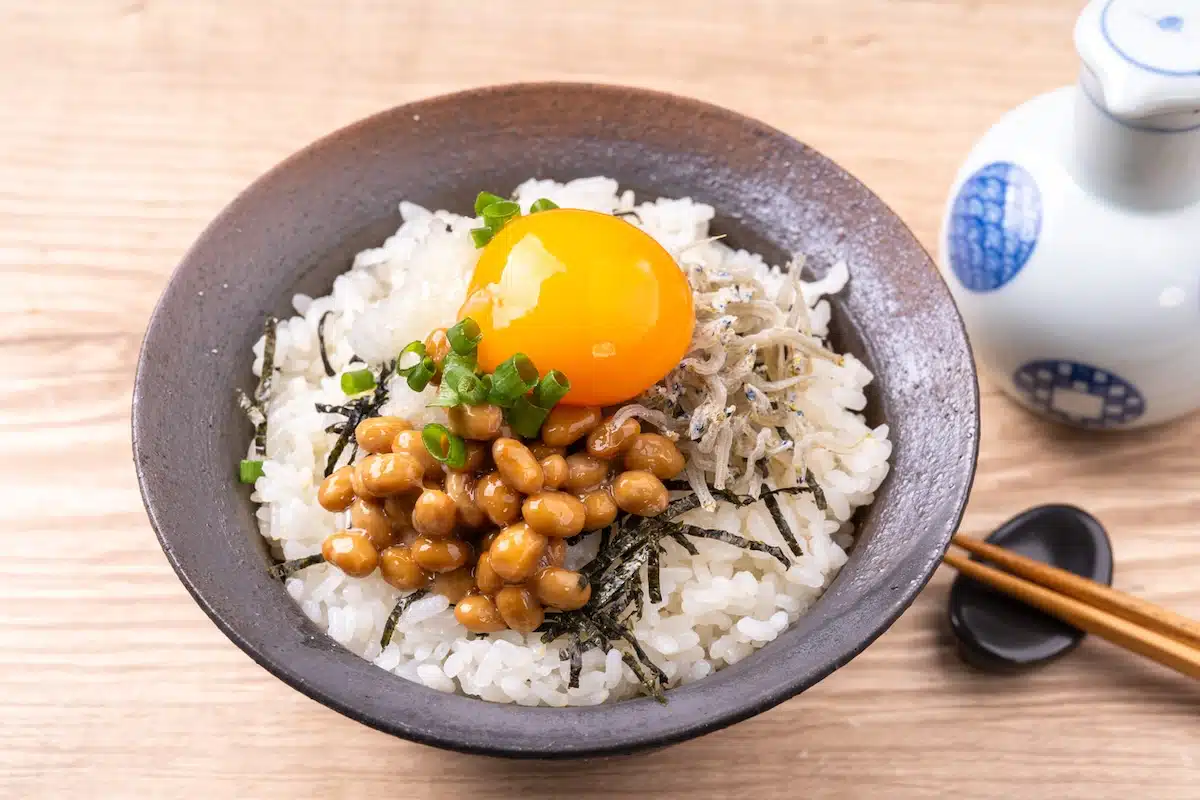
The Japanese Longevity Food You’ve Probably Never Heard Of
When we talk about Japanese longevity, certain things tend to come up again and again: green tea, fish, walking, fermented foods, smaller portions and the concept of ikigai.
But there is another traditional Japanese food that gets considerably less attention in the West.
It’s called natto.
If you’ve ever seen it, you probably remember it. Natto is made from fermented soybeans and has a very distinctive sticky, stringy texture and strong smell. It’s certainly not the easiest Japanese food to introduce to a Western breakfast table.
But nutritionally, natto is fascinating. It contains protein, fiber, vitamin K2 and various compounds produced during fermentation. Most interestingly for longevity, natto is the natural source of an enzyme called nattokinase, which has become increasingly studied for its potential effects on cardiovascular health and circulation.
And when researchers have looked at people who actually eat natto regularly, the results are difficult to ignore.
What Is Natto?
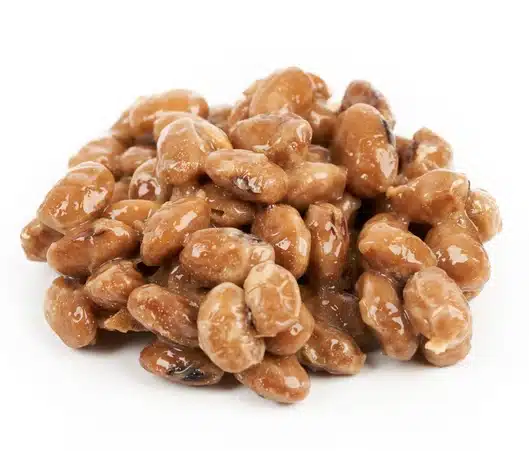
Natto is a traditional Japanese food made by fermenting soybeans with the bacterium Bacillus subtilis var. natto.
Fermentation transforms ordinary cooked soybeans into something quite different. The beans develop their characteristic sticky strings, strong aroma and distinctive flavor, while the fermentation process also produces biologically active compounds.
Natto has been eaten in Japan for centuries and is commonly served with rice, often at breakfast. It may not look like a typical “superfood”, but what interests me about natto is that it isn’t some newly invented longevity product. It’s a traditional food that has been part of the Japanese diet for generations.
And modern research is now giving us some clues as to why it may be so interesting.
Could Natto Be One of Japan’s Longevity Foods?
Japan consistently ranks among the countries with the world’s highest life expectancy, and there obviously isn’t one food responsible for that. Japanese longevity is influenced by an entire lifestyle and dietary pattern. But research into natto specifically has produced some fascinating findings.
In the Takayama Study, researchers followed 29,079 Japanese men and women for 16 years. Those consuming the highest amount of natto had a 25% lower risk of dying from cardiovascular disease compared with those consuming the least. Higher natto intake was also associated with a lower risk of stroke mortality.
Interestingly, the same relationship wasn’t seen with total soy protein or soy isoflavones from other soy foods. That suggests there may be something particularly interesting about natto itself.
Another large Japanese study published in The BMJ followed 92,915 men and women for an average of almost 15 years. Higher consumption of fermented soy foods was associated with lower all-cause mortality, while natto consumption specifically was associated with lower cardiovascular mortality in both men and women.
Of course, these are observational studies. They show an association rather than proving that eating natto directly prevents cardiovascular disease or makes you live longer.
But when a traditional food consumed by one of the world’s longest-lived populations repeatedly shows associations with cardiovascular health and mortality, I think it’s worth taking a closer look.
What Makes Natto So Special?
Natto isn’t simply fermented soy. The fermentation process produces several interesting compounds, but one in particular has attracted considerable attention: Nattokinase.
Nattokinase is an enzyme first identified in natto in the 1980s. What makes it particularly interesting is its fibrinolytic activity. That sounds complicated, but the basic idea is much easier to understand. Fibrin is a protein involved in blood clot formation. Fibrinolysis is the body’s natural process for breaking fibrin down again when it is no longer needed.
Nattokinase has demonstrated fibrinolytic activity, which is why researchers have become interested in its potential role in supporting healthy blood flow and cardiovascular health.
And considering cardiovascular disease remains the leading cause of death globally, anything that may support cardiovascular function naturally is going to attract my attention from a longevity perspective.
What Does Research Say About Nattokinase and Heart Health?
Nattokinase research has moved beyond laboratory experiments.
A systematic review and meta-analysis examining six randomized controlled trials involving 546 participants found that nattokinase supplementation significantly reduced both systolic and diastolic blood pressure compared with control groups.
The average reductions weren’t enormous, around 3.45 mmHg systolic and 2.32 mmHg diastolic, but cardiovascular risk is influenced by what happens over decades, not days.
The same analysis found mixed results for cholesterol and other metabolic markers, so I don’t think nattokinase should be presented as some kind of miracle supplement that fixes every cardiovascular risk factor. That’s not what interests me about it anyway.
What interests me is that we have a traditional fermented food associated with lower cardiovascular mortality in large Japanese populations, containing an enzyme that has measurable biological activity and has now also been investigated in controlled human trials. That’s a much more interesting story.
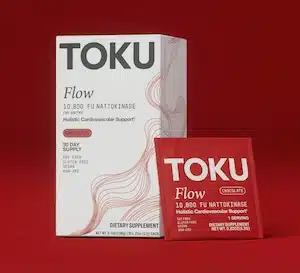
Want to Try Nattokinase?
I recommend Toku Flow, a high-potency nattokinase formula designed to support cardiovascular health and healthy blood flow.
Get 20% off with code KAJSA
Natto Is More Than Nattokinase
It’s easy to focus entirely on nattokinase, but natto contains more than one potentially useful nutrient. One of the most notable is vitamin K2, particularly menaquinone-7 or MK-7.
Vitamin K2 is involved in calcium metabolism. It helps activate proteins involved in directing calcium toward places where we want it, such as our bones, rather than allowing inappropriate calcium deposition elsewhere in the body.
That makes K2 particularly interesting when we’re talking about both bone health and cardiovascular health, two areas that become increasingly important as we age. Natto also provides protein, fiber and compounds created through fermentation. So when we look at the associations between natto consumption and health, we shouldn’t automatically assume nattokinase alone explains everything we’re seeing. As is so often the case in nutrition, the whole food is more complicated than one isolated compound.
The Problem With Natto: You Have to Eat It
Here’s where things get slightly more difficult. I love learning from traditional diets, particularly Japanese food culture, but I’ll admit that natto is an acquired taste. The smell is strong. The texture is sticky. And when you lift a spoonful, long strings stretch between the beans and the bowl.
For someone who has eaten natto since childhood, that’s completely normal. For someone trying it for the first time at 42, it can be… an experience. And realistically, most people reading Hacks4Wellness probably aren’t going to start eating a bowl of fermented soybeans every morning just because they’ve read one article about Japanese longevity.
Fortunately, natto itself isn’t the only way to get nattokinase.
Can You Get Nattokinase Without Eating Natto?
Yes.
Nattokinase can be produced through fermentation and taken as a supplement, which provides a much more practical option for people interested specifically in the enzyme. This is also where quality and dosage become important.
Nattokinase activity is commonly measured in FU, or fibrinolytic units, rather than simply milligrams. When comparing products, I therefore think it’s more useful to look at enzyme activity than at how impressive the milligram number looks on the front of a bottle.
I’ve written a separate deep dive into nattokinase, how it works and the research behind it in “Unlock Longevity With Nattokinase: The Science-Backed Japanese Secret for Better Blood Flow.”
If you want to understand nattokinase itself in more detail, I recommend reading that next.
The Nattokinase I Recommend
If eating natto every morning doesn’t sound particularly appealing, this is where supplementation becomes interesting. The product I recommend is Toku Flow.
What makes it unusual is that Toku produces its nattokinase through chickpea fermentation rather than soy, making the finished product soy-free.
Each daily sachet provides 10,800 FU of nattokinase, together with vitamin K2 in the MK-7 form and beta-glucan from gluten-free oats. I particularly like that combination because it doesn’t treat cardiovascular health as a one-ingredient problem.
You get nattokinase for its fibrinolytic activity, K2 for its role in normal calcium metabolism, and oat beta-glucan, a soluble fiber with its own established relationship with cardiovascular and metabolic health.
Toku also third-party tests the product for purity and potency.
If you’re interested in adding nattokinase to your longevity routine, you can explore Toku Flow here (20% off with code KAJSA).
If you take anticoagulants, antiplatelet medication or other medication affecting blood clotting, speak with your healthcare provider before using nattokinase.
What Natto Can Teach Us About Longevity
Perhaps what I find most interesting about natto isn’t that we’ve discovered another “superfood.” It’s almost the opposite. Natto isn’t new. It isn’t a Silicon Valley biohack, and it wasn’t invented by a supplement company. It’s a traditional fermented food that people in Japan have been eating for generations, and only much later did researchers begin investigating the compounds it contains and their potential effects on human health.
I think there is something worth learning from that. Longevity research often sends us searching for the newest molecule or technology, while some of the most interesting clues may already exist in traditional diets and lifestyles. That doesn’t mean eating natto guarantees a longer life. But the combination of population research, cardiovascular associations, fermentation, vitamin K2 and nattokinase makes it one traditional food I think deserves considerably more attention in the West.
And if you’re not quite ready for sticky fermented soybeans at breakfast? There are easier ways to get the most interesting part.
Frequently Asked Questions About Natto and Nattokinase
What is natto?
Natto is a traditional Japanese food made from soybeans fermented with Bacillus subtilis var. natto. It has a strong smell and distinctive sticky texture and is particularly notable for containing vitamin K2 and the enzyme nattokinase.
Is natto good for longevity?
No food can guarantee longevity. However, large observational studies in Japan have associated higher consumption of fermented soy foods with lower all-cause mortality, while natto consumption has specifically been associated with lower cardiovascular mortality.
What is nattokinase?
Nattokinase is an enzyme produced during the fermentation process used to make natto. It has fibrinolytic activity, meaning it interacts with processes involved in the breakdown of fibrin, which has made it an interesting area of cardiovascular research.
Is nattokinase good for blood pressure?
Human trials suggest it may have a modest effect. A meta-analysis of randomized controlled trials found nattokinase supplementation was associated with reductions in both systolic and diastolic blood pressure.
Does nattokinase contain vitamin K2?
Natto naturally contains substantial amounts of vitamin K2, particularly MK-7. Nattokinase itself is an enzyme and is not the same thing as vitamin K2, so the amount of K2 in a nattokinase supplement depends on the formulation.
Can I take nattokinase instead of eating natto?
You can supplement nattokinase without eating natto, but that isn’t nutritionally identical to eating the whole fermented food. Natto contains protein, fiber, vitamin K2 and other compounds in addition to nattokinase.
Who should not take nattokinase?
Because nattokinase has fibrinolytic activity, people taking anticoagulants, antiplatelet drugs or other medications affecting blood clotting should discuss nattokinase with their healthcare provider before using it. The same applies if you have a bleeding disorder or are preparing for surgery.


