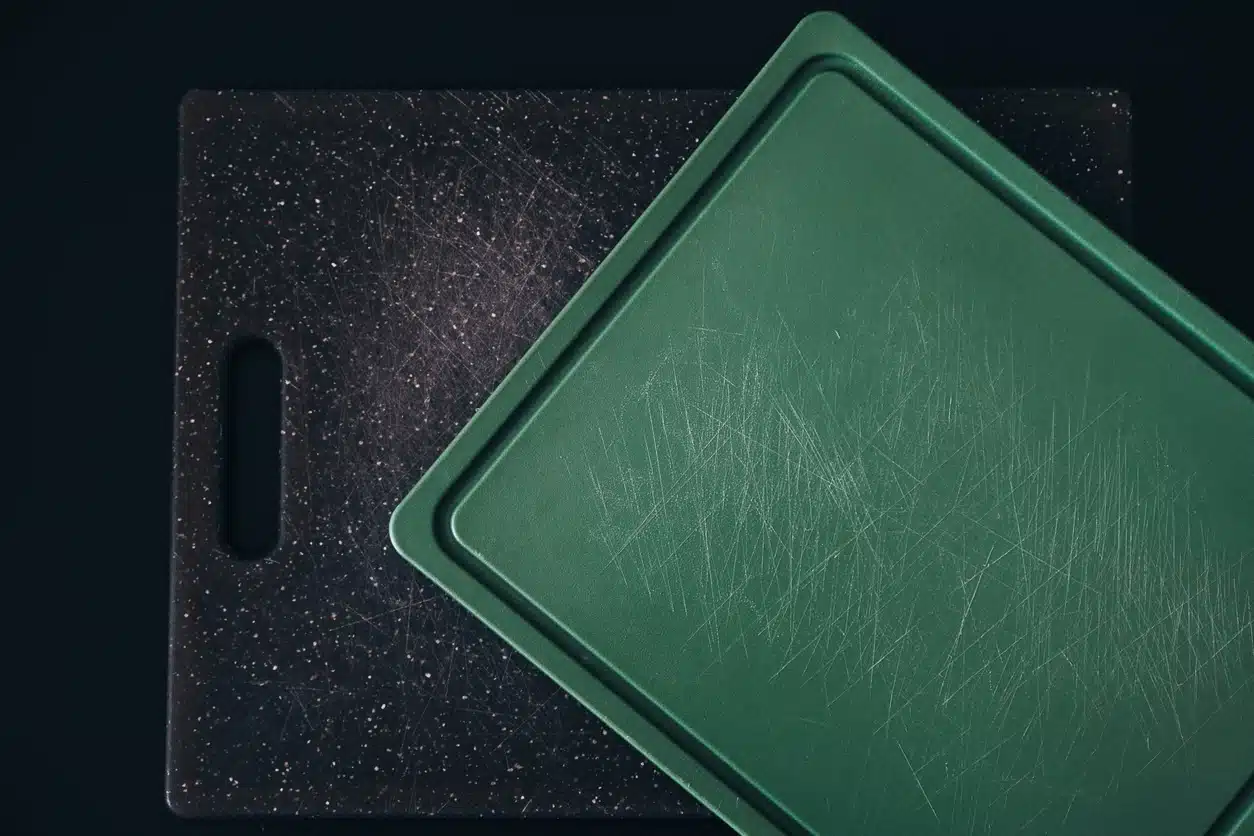
The Hidden Health Risk Lurking in Your Kitchen: Microplastics from Cutting Boards
Most of us are careful about what we eat, but rarely think about what our food is being cut on. Recent research published in Environmental Science & Technology (2023) revealed a shocking fact: we may ingest up to 50 grams of microplastics every year from plastic cutting boards alone. That’s the equivalent of eating a full credit card’s worth of plastic every single week. Just the thought of that makes me feel really bad.
What Are Microplastics
Microplastics are tiny plastic particles less than 5 mm in size, and they’re now being detected everywhere in the human body. Scientists have found them in the bloodstream, in organs, testicular tissue, breast milk, placenta, and even the brain.
Early research links microplastic exposure to:
– Hormone disruption (endocrine interference)
– Reduced fertility in both men and women
– Chronic inflammation and oxidative stress
– Neuroinflammation and cognitive decline
– Increased cancer risk
Unlike natural materials, microplastics don’t just pass through. Some accumulate, and the long-term effects are still being uncovered. That’s why they’re increasingly being referred to as “forever chemicals.” Even among biohackers and longevity aspirants, this is still a relatively new field, which is often overlooked.
An Overlooked Source: Plastic Cutting Boards
Every slice of a knife shaves off microscopic plastic particles. These particles cling to food, enter your body, and add to your total plastic load. This happens day after day. If you care about clean eating, gut health, hormone balance, and longevity, it’s time to think beyond what’s on your plate — and start thinking about what’s under it.

Titan Haus Pure Titanium Cutting Board
Titan Haus has created the world’s only multi-agency certified pure titanium cutting board, designed to eliminate this invisible source of microplastic exposure.
Why it stands out:
🛡️ Toxin-Free: Zero microplastics, chemicals, or leaching metals
🦠 Bacteria-Free: Non-porous and naturally antibacterial
⚡ Unmatched Durability: No warping, cracking, staining, or odors
🌍 Truly Sustainable: Buy-it-for-life, not landfill filler
🔪 Knife-Safe: Gentle on blades, unlike glass or stone
For anyone serious about optimizing health, longevity, and performance, removing microplastics from your daily routine is a small shift that can have a massive long-term impact.
Offer: Get 15% off your order with code: KAJSALONGEVITY15
Other Everyday Sources of Microplastics
Plastic cutting boards are just one piece of the puzzle. In reality, microplastics are silently entering our bodies from many everyday sources, often without us realizing it.
Some of the most common include:
– Plastic water bottles — especially when exposed to heat or reused multiple times.
– Plastic food containers and packaging — friction, heat, and repeated washing can release particles.
– Synthetic clothing (like polyester or nylon) — sheds microfibers during washing that end up in water and the food chain.
– Tea bags made of plastic mesh — release billions of microplastic particles when steeped in hot water.
– Household dust — now known to contain airborne microplastics from textiles, packaging, and carpets.
Even if you eat clean, move daily, and optimize your supplements, constant low-level exposure to microplastics can quietly undermine your health.
Final Thoughts
I do my best to stay away from microplastics, but the truth is, it’s impossible to avoid them completely in our modernized world. Switching out my plastic cutting board was my first step. Now, I also only use glass containers for my food, and I’ve installed an air purifier in my bedroom to reduce airborne particles.
There’s still a lot left to do in terms of optimizing, but for me it’s not about being perfect — it’s about taking small steps toward a cleaner, healthier environment for my body to thrive in.