


Adaptogens Explained: Can They Really Help Your Body Handle Stress?
Stress has become such a normal part of modern life that sometimes we barely notice it anymore. Work deadlines. Notifications. Poor sleep. Hard workouts. Family responsibilities. Too much caffeine. Not enough downtime. Even things we choose because they’re good for us, like exercise, still place temporary stress on the body.
Recently, I’ve become increasingly interested in adaptogens, a group of herbs, roots and mushrooms that are often described as helping the body become more resilient to stress.
The wellness world has certainly embraced them. You’ll now find adaptogens in everything from coffee and gummies to powders, supplements and functional drinks.
But what exactly is an adaptogen? Do they actually lower cortisol? And are medicinal mushrooms like Lion’s Mane really adaptogens?
What Are Adaptogens?
The concept isn’t new. The term adaptogen emerged in the Soviet scientific literature in the mid-20th century and was originally used to describe substances thought to increase the body’s nonspecific resistance to different types of stress. Over time, the definition evolved to include substances that may help the body adapt to physical, biological and psychological stressors while supporting normal physiological function.
That’s quite different from simply saying an adaptogen “reduces stress.” The idea is that an adaptogen may help improve the body’s ability to respond and adapt to stress. And that’s what I find particularly interesting.
We don’t want to eliminate stress entirely. Exercise is stress. Cold exposure is stress. Learning something difficult is stress. What matters is our ability to respond, recover and return to balance.
Let’s take a closer look.
How Do Adaptogens Work?
Our stress response involves several interconnected systems, including the nervous system and the hypothalamic-pituitary-adrenal (HPA) axis. When we encounter a stressor, the HPA axis helps coordinate the hormonal response that ultimately includes the release of cortisol.
Again, cortisol isn’t bad. We need it.
Problems can arise when stress becomes chronic and the body doesn’t get enough opportunity to recover.
Adaptogens appear to interact with several pathways involved in the stress response rather than operating through one simple mechanism. Research has investigated effects on the HPA axis, cortisol and cellular stress-response pathways, among others.
This is also why I don’t particularly like the phrase “cortisol-lowering supplement.” The goal isn’t necessarily to push cortisol down. It’s supporting a healthy response to stress.
Why Are Adaptogens Suddenly Everywhere?
Adaptogens may be trendy, but many of the plants themselves certainly aren’t new. Ashwagandha has a long history in Ayurveda. Ginseng has been used in traditional Asian medicine for centuries. Rhodiola has a history of traditional use in Europe and Asia.
What’s changed is how they’re being used. Instead of visiting a traditional practitioner, people are adding mushroom powders to coffee, taking ashwagandha before bed or using blends designed for energy, focus, stress or recovery.
I think their popularity also reflects something bigger.
We’re increasingly interested not only in treating disease, but in becoming more resilient.
And that’s very much where adaptogens fit into the longevity conversation.

Adaptogens Without the Complicated Routine
Interested in adaptogens and functional mushrooms but don’t want ten different bottles in your cupboard?
I’ve partnered with Barker Wellness, founded by Travis Barker. Their mushroom adaptogen gummies combine functional mushrooms and adaptogenic ingredients into easy formulas for energy & focus, brain health, and nighttime recovery.
The Adaptogens Worth Knowing
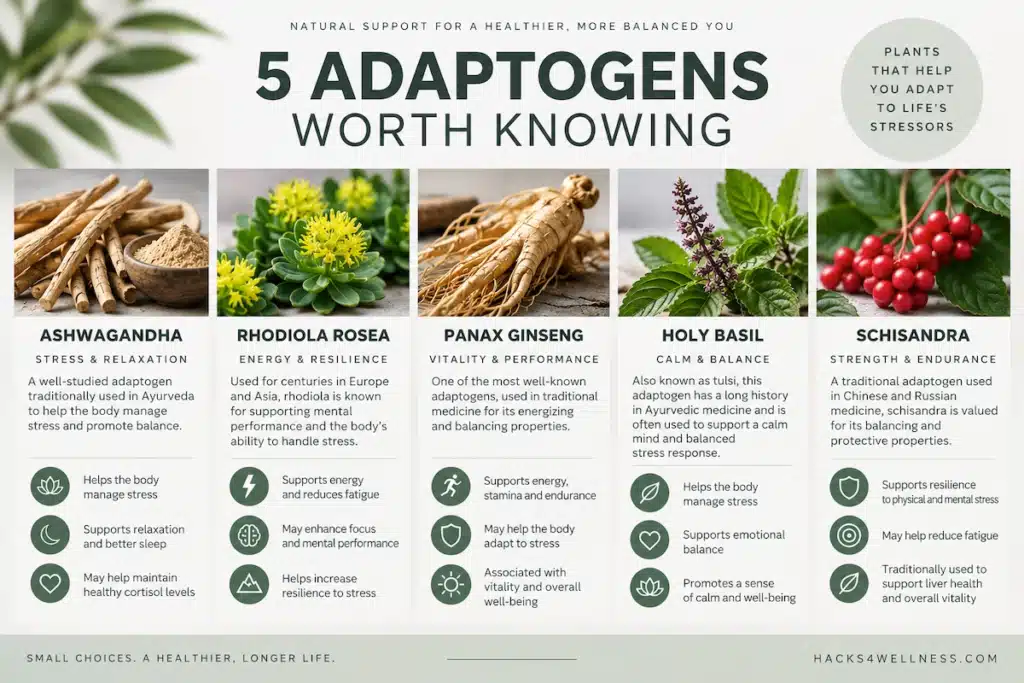
There are dozens of plants marketed as adaptogens today, but a handful come up again and again.
Ashwagandha
Ashwagandha (Withania somnifera) is probably one of the best-known adaptogens.
It’s particularly interesting in relation to stress and anxiety. Recent systematic reviews and meta-analyses of randomized controlled trials have found improvements in perceived stress and anxiety and reductions in cortisol compared with placebo, although researchers still call for better data on optimal doses and long-term safety.
Rhodiola Rosea
Rhodiola is traditionally associated with fatigue, stamina and mental performance under stress.
Research has investigated it particularly in situations involving fatigue and mental exhaustion. Reviews of adaptogen research have reported potential benefits for mental performance and tolerance to fatigue, although the strength of the evidence varies depending on the preparation and outcome being studied.
This is why you’ll often see rhodiola included in daytime rather than nighttime formulas.
Panax Ginseng
Ginseng may be one of the original wellness ingredients.
It’s traditionally used for vitality and resilience and remains one of the better-known botanical adaptogens. Modern research has explored its effects on fatigue, cognition, metabolic function and the body’s stress-response systems.
Holy Basil
Holy basil, also known as tulsi, has a long history of use in Ayurvedic traditions. Today you’ll often find it in formulas marketed for relaxation and stress support rather than stimulation.
Schisandra
Schisandra is a berry traditionally used in Chinese and Russian herbal medicine and is another of the classic adaptogens. Research has explored its potential effects on physical performance, fatigue and mental performance under stress.
And then we get to a category that has absolutely exploded in popularity…
Are Medicinal Mushrooms Adaptogens?
This is where terminology becomes a little messy. Functional or “medicinal” mushrooms are frequently grouped together with adaptogens, although technically not every functional mushroom meets the traditional definition of an adaptogen.
Still, there’s considerable overlap in how they’re used. Some of the names you’ll see repeatedly are:
Lion’s Mane for cognition and focus
Reishi for relaxation and immune support
Cordyceps for energy and physical performance
Chaga for its antioxidant compounds
Turkey Tail for immune support
And the mushroom I’ve personally been most interested in is Lion’s Mane.
My Experience With Lion’s Mane

I’ve tried Lion’s Mane myself, and it’s one of those supplements where I’ve actually felt a difference. For me, the biggest thing has been focus.
When I take it, I feel like I’m better able to concentrate on what I’m doing and simply get more done. It’s difficult to quantify something like productivity in everyday life, of course, but that’s been my personal experience with it.
Interestingly, cognition is also where much of the Lion’s Mane research is focused.
A 2023 randomized, double-blind pilot study involving healthy adults aged 18–45 found faster performance on one cognitive task 60 minutes after Lion’s Mane supplementation. After 28 days, researchers also observed a trend toward reduced subjective stress, although the study was small and several other cognitive outcomes didn’t significantly improve.
Another randomized pilot trial found improvements in measures of cognitive processing following eight weeks of supplementation, while a 2024 review of human mushroom studies concluded that Lion’s Mane has shown some promising effects on cognition and mood but that intervention results remain mixed and larger trials are needed.
So I’m not going to tell you that Lion’s Mane will turn you into a productivity machine. BUT the early research is interesting, and my own experience has been positive enough that Lion’s Mane has stayed on my radar.
A New Addition to My Wellness Toolkit: Barker Wellness
I’ve recently partnered with Barker Wellness, the wellness brand founded by Travis Barker.
What immediately caught my attention was their use of functional mushrooms and adaptogens in combination, rather than requiring you to buy a shelf full of individual powders and supplements.
Their sugar-free Daytime Mushroom Adaptogen Gummies, for example, contain Lion’s Mane, Cordyceps, Reishi, Shiitake, Turkey Tail and Tremella alongside adaptogenic ingredients including ashwagandha, Panax ginseng and schisandra.
They also have a dedicated Brain Health, Memory & Focus formula and a Nighttime Mushroom Adaptogen formula designed around sleep and recovery.
Can Adaptogens Help With Sleep?
Potentially, but once again it depends on the ingredient. You wouldn’t necessarily take something associated with energy and mental performance immediately before bed just because it’s classified as an adaptogen.
This is why formulations matter.
Ashwagandha is commonly studied in relation to stress, while ingredients such as holy basil are often used in calming blends. Reishi is also frequently incorporated into nighttime functional-mushroom products.
Barker Wellness’s Nighttime formula, for example, combines Reishi, Lion’s Mane, Cordyceps and Chaga with ingredients including ashwagandha, holy basil, lemon balm, L-theanine, passionflower, valerian and GABA.
Personally, I think this is a more useful way to approach adaptogens than simply asking which one is “best.”
How Long Do Adaptogens Take to Work?
This is another area where expectations can get unrealistic. Adaptogens generally aren’t something I would approach like caffeine, where you expect an obvious effect within 30 minutes.
Some studies evaluate outcomes after several weeks of consistent supplementation. For example, ashwagandha trials included in recent reviews commonly measured stress outcomes after weeks of use, while Lion’s Mane studies have examined both acute and longer-term supplementation.
That doesn’t mean everybody needs to take an adaptogen for months before noticing anything. It simply means that effects can depend on the ingredient, dose, formulation, person and outcome you’re looking for.
Are Adaptogens Safe?
“Natural” doesn’t automatically mean harmless. Adaptogens and mushroom extracts contain biologically active compounds, and different ingredients have different safety profiles.
Some may interact with medications or be inappropriate during pregnancy, breastfeeding or for people with certain health conditions. Ashwagandha, for example, deserves additional caution for people with thyroid or autoimmune conditions and has also been linked to rare cases of liver injury.
The quality of supplements matters too.
If you’re taking medication or managing a medical condition, it’s sensible to speak with your healthcare provider or pharmacist before adding concentrated herbal or mushroom supplements.
And I would be particularly cautious about stacking multiple adaptogen products without realizing that they contain many of the same ingredients.
Adaptogens are a fascinating area of wellness, and one I’m personally enjoying exploring more. My experience with Lion’s Mane has been particularly positive, especially for focus and productivity, and I’m curious to see where the research on adaptogens and functional mushrooms goes from here.
For now, I see them as an interesting addition to my longevity toolkit, and certainly a topic worth keeping an eye on.
Frequently Asked Questions About Adaptogens
What are adaptogens?
Adaptogens are a group of herbs and other natural substances traditionally described as helping the body adapt to physical and psychological stress. Research suggests some may influence systems involved in the stress response, including the HPA axis, but effects vary considerably between individual ingredients.
What are the best adaptogens for stress?
Ashwagandha is among the most studied adaptogens for stress. Meta-analyses of randomized trials have found improvements in perceived stress and anxiety and reductions in cortisol compared with placebo, although more research is needed on long-term use and optimal dosing.
Do adaptogens lower cortisol?
Some may influence cortisol, but adaptogens shouldn’t simply be thought of as “cortisol-lowering supplements.” Ashwagandha has produced reductions in cortisol in clinical trials involving stressed adults, but cortisol is an essential hormone and naturally fluctuates throughout the day.
Is Lion’s Mane an adaptogen?
Lion’s Mane is more accurately described as a functional or medicinal mushroom, although it’s frequently grouped with adaptogens in wellness products. It’s primarily studied for potential effects on cognition, mood and neurological health. Human evidence is promising but still developing.
Does Lion’s Mane improve focus?
Some small human studies have reported improvements in specific measures of cognitive performance, but the evidence isn’t yet strong enough to say that Lion’s Mane reliably improves focus for everyone. Personally, I’ve noticed better focus and productivity when using it, but that’s my individual experience rather than proof of an effect.
Can you take adaptogens every day?
Many adaptogen studies involve daily supplementation for several weeks, but whether daily long-term use is appropriate depends on the specific ingredient, dose, medications and individual health circumstances. It’s better to evaluate the safety of the actual ingredient than assume all adaptogens can be treated as one category.
Can I take several adaptogens together?
Adaptogens are frequently combined, but check labels carefully because multi-ingredient formulas can overlap. Taking several products may unintentionally result in much larger amounts of particular herbs than you intended. If you’re taking medication or have a medical condition, discuss combinations with a healthcare professional.


